By Davida Spaine Solomon
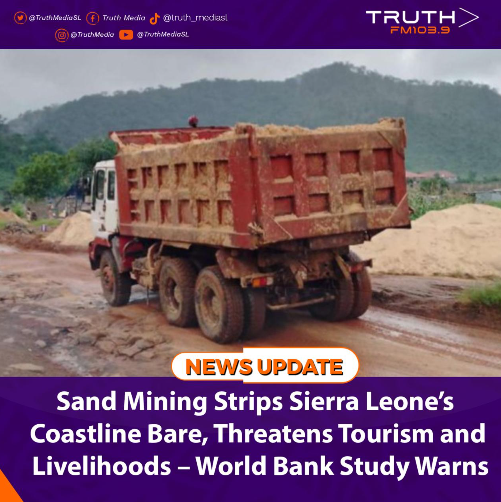
Lungi, 7th April 2026 – A blunt warning has emerged from the Go Circular Week coastal engagement sessions: unchecked sand mining is eroding Sierra Leone’s coastline, undermining tourism, and trapping vulnerable communities in cycles of poverty.
Presenting findings from the Sierra Leone Circular Economy Project, World Bank Consultant Alie Jalloh revealed the scale of extraction across the Western Area and the Lungi-Mahera corridor, painting a troubling picture of an industry operating at immense environmental and economic cost.
The study shows sand mining is concentrated in ecologically fragile zones, worsening coastal vulnerability. Since 2000, Sierra Leone’s shoreline has retreated by an average of 53 metres, with hotspots such as Hamilton, John Obey, and Lumley Beach directly linked to mining activity.
The country’s tourism belt is already suffering. Nearly 60 percent of hotels along Lakka to Hamilton report structural damage from erosion and sand loss. Once-pristine beaches are degrading, weakening Sierra Leone’s appeal as a destination and discouraging investment.
The social toll is severe. While sand mining provides income, it simultaneously destroys the natural resources communities depend on, leaving them vulnerable to flooding and weakened infrastructure. Revenue distribution is also skewed: truck drivers and transport operators capture up to 85 percent of earnings, while miners and local communities receive little or no compensation.
Despite relatively modest demand, estimated at 1.4 tons per capita annually, total extraction in the study area reaches 1.25 million cubic metres per year. Governance remains weak, with fragmented oversight and limited enforcement. Current controls, such as fixed extraction days, are not scientifically based, allowing mining to exceed natural replenishment rates.
Global case studies offer hope. Vietnam has adopted extraction quotas based on scientific data, Mauritius phased out sand mining by investing in alternatives, and Kenya’s Makueni County has curbed illegal mining through community-led enforcement.
The report calls for urgent reforms, including a national sand mining policy, a central oversight body, and scientifically guided extraction limits. It recommends traceability systems to monitor transport routes, investment in alternative construction materials, and sustainable livelihoods such as tourism and aquaculture. Crucially, it stresses the need for a “just transition” to support communities dependent on sand mining.
As discussions in Lungi made clear, sand is no longer just a construction material, it is a finite resource. Without decisive action, continued depletion could accelerate environmental degradation, weaken infrastructure, and erode the very economic sectors Sierra Leone seeks to grow.
For coastal communities already on the frontline, the cost of inaction is visible in disappearing shorelines, collapsing buildings, and shrinking livelihoods. The challenge now lies in turning evidence into policy, and policy into action.