By Bakiatu Kanu
Freetown, 30th March, 2026 –Tattoos have been part of human culture for thousands of years, from the tribal markings of Polynesia and Africa to the symbolic designs of ancient Egypt. Traditionally, they were more than decoration-they marked identity, bravery, milestones, and even spiritual beliefs.
Today, tattoos have evolved into a powerful form of self-expression and art, celebrated for their creativity and individuality. Yet, while many wear tattoos with pride, others get them on a whim, unaware of their meanings or the potential risks to their skin. Some admire tattoos on others but would never choose one for themselves.
As people age, questions often arise: will this mark still feel meaningful years from now? Do we fully understand the health implications, from infections to allergic reactions?
This story explores the history, culture, and meaning of tattoos, as well as the risks involved, through the perspectives of dermatologists, religious leaders, tattoo artists, and the people who wear them.
While tattoos have evolved into a modern form of self-expression, tattoo artists say the meaning behind them often depends on the individual. For some, tattoos carry deep personal significance, while for others, they are simply aesthetic choices.
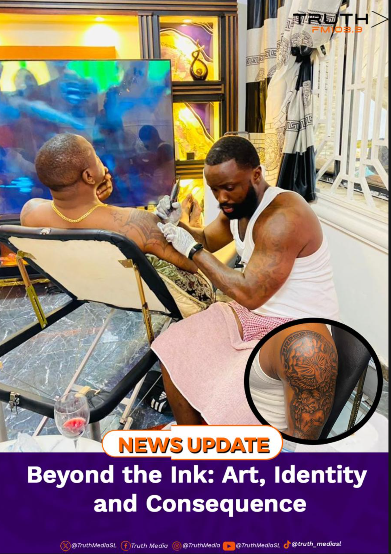
Mo Conteh, popularly known as Max Ink, is a professional tattoo artist based in Wilberforce. Though many initially knew him for football, he says his passion eventually shifted into tattooing-a craft he has practiced for four to five years and now considers a full-time career.
“I tattoo because it is part of me-it’s who I am,” he said. “Every tattoo on my body has a meaning that I respect. I don’t just tattoo for the sake of it.”
Known for his expertise in portrait tattoos, Max says his work focuses largely on permanent designs that reflect identity and emotion. He has tattooed a number of high-profile individuals in Sierra Leone and takes pride in his growing reputation.
“A tattoo should connect with you as a whole,” he explained.
Max noted that while some clients come with clear meanings behind their designs, others lack proper knowledge about tattoos. In such cases, he takes time to educate them before proceeding.
“Some people just want to tattoo names or dates without understanding what it means long-term,” he said. “I guide them so they can make better decisions.”
Despite his passion for the art, Max emphasized that safety remains a major concern in the industry.
“Always watch the needles being used and make sure they are new,” he said. “You have to protect yourself because of the diseases out there.”
He also highlighted the importance of proper aftercare.
“It doesn’t mean because I did a tattoo beautifully that it will stay that way if you don’t take care of it. Don’t scratch it, don’t use chemicals maintain it properly.”
Max, who comes from a Muslim background, says he welcomes people from all walks of life, as long as there is mutual respect.
“Even here in Sierra Leone, we can do what the Western world does and we can do it properly,” he added.
However, beyond the art and personal expression, medical experts warn that tattoos come with potential health risks that many people overlook.
Dr. John Stevens Mbeteh, a specialist dermatologist at Connaught Hospital, says while people get tattoos for different reasons, the risks remain the same regardless of intention.
“A lot of people do tattoos for fashion, cultural purposes, or identification, but irrespective of what you do it for, there are side effects,” he explained.
One major concern is infection caused by unsterilized needles.
“If the needle used is not properly sterilized, it can transmit infections such as hepatitis B, HIV, or bacterial infections,” he said.
He also warned that certain skin types are more vulnerable to complications. Individuals prone to skin reactions may develop keloids raised scars that can be difficult to treat.
“Allergic reactions are also common, especially with temporary tattoos like henna,” he added, noting that such reactions are caused by chemicals in the ink.
Dr. Mbeteh further explained that tattoos can trigger more complex conditions such as sarcoidosis, which causes swelling around the tattooed area.
Beyond physical health, he highlighted possible psychological effects.
“For example, someone may tattoo the name of a partner permanently, and later the relationship ends. Removing it can be difficult and expensive,” he said.
Although tattoo-related complications are not extremely common in hospitals, he stressed the importance of precaution.
“Always go to a qualified tattoo artist, ensure needles are sterilized, and never share needles,” he advised. “If you have sensitive skin or allergies, you should avoid tattoos altogether.”
Beyond health concerns, tattoos also raise questions within religious communities, where beliefs about body modification often shape personal choices.
Sheik Yunis Kallay explained that in Islam, altering the body permanently is generally discouraged.
“Anything that concerns tattoo or any form of harsh makeup that changes a human’s skin is a form of surgery for that mark to stay on your body,” he said.
Similarly, Pastor Sheaka Kamara emphasized the importance of preserving the body from a Christian perspective.
“We are called to keep our bodies holy and set apart,” he said. “Permanent markings may contradict the idea of preserving what God created perfectly.”
While both perspectives differ in approach, they reflect a shared concern about maintaining the natural state of the body.
While experts and religious leaders offer guidance, individuals with tattoos say their choices are deeply personal.
John, who has a permanent tattoo, says his body art reflects his Christian faith.
“I have a religious tattoo-my favourite scripture in the Bible, John 3:16,” he said, adding that he hopes to get more tattoos in the future.
Another respondent, who preferred to remain anonymous, described tattoos as a meaningful part of her life’s journey.
“Tattoo means a lot to me because I have many on my body. Some reflect my belief system and religion, while others remind me of how far I’ve come in life,” the respondent said.
“I don’t plan on taking them off anytime soon. If possible, I would even want more because it’s something I love and enjoy seeing on my body even as I grow old.”
From ancient traditions to modern-day expression, tattoos continue to hold different meanings for different people. While artists celebrate them as a form of identity and creativity, medical experts warn of potential health risks, and religious leaders urge caution based on spiritual beliefs.
Ultimately, the decision to get a tattoo remains a personal one-shaped by knowledge, intention, and awareness of both its significance and consequences.
As tattoos grow in popularity, the question remains: are they simply marks on the skin, or lasting symbols that carry meaning far beyond the surface?