By Kelfala Kargbo
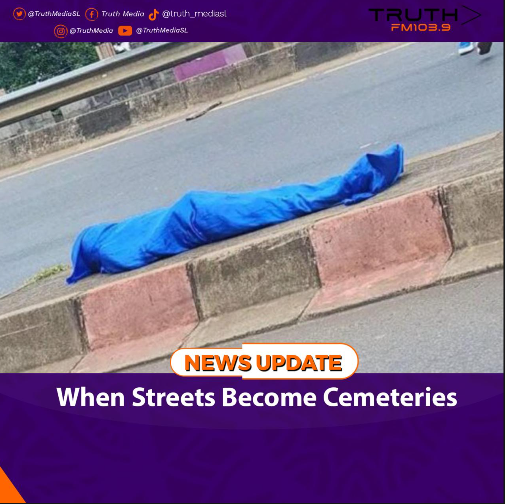
Freetown, 30th March, 2026 – Freetown’s streets are turning into open-air cemeteries. In the past two years alone, the capital has recorded its highest number of destitute deaths, with more than 200 corpses found between August and September 2025, according to data released by Mayor Yvonne Aki-Sawyerr.
For residents and pedestrians, the sight has become disturbingly familiar: bodies abandoned at junctions, near schools, and even outside government buildings. Many remain unattended for days, decomposing in public view and releasing foul odors that force passersby to cover their noses.
On March 11, 2025, a corpse lay opposite City Hall, covered in a white cloth. Residents said it had been there for nearly four days just blocks away from the Central Police Division. “Right now, when you walk near these bodies, you will notice the smell,” one pedestrian told Truth Media, describing the fear and discomfort of navigating the city’s streets.
Behind the crisis lies a bureaucratic tug-of-war. Late last year, a political stalemate emerged over which institution is responsible for removing corpses.
The Freetown City Council insists it no longer holds that mandate, saying the duty now lies with the Sierra Leone Police (SLP) Emergency Unit. Under current protocols, the police are tasked with collecting, examining, and burying bodies, while the council provides graves for “dignified burial.”
But the police admit they are struggling. Speaking to Truth Media, the SLP emergency unit confirmed they lack adequate ambulances. “The only ambulance we have sometimes goes to the provinces to pick up other dead bodies,” an officer disclosed. As a result, corpses often remain on the streets for days before collection.
The delays have left residents grappling with silent health hazards. Decomposing bodies in public spaces pose risks of disease transmission, while the psychological toll of seeing corpses daily has sparked outrage.
Despite repeated calls to emergency lines, residents say responses are slow and inconsistent. “We always relay the message to respondents for action,” the police explained, “but in most instances, there have been delays.”
As the blame game continues between the council and the police, Freetown’s streets remain littered with reminders of systemic failure. For citizens, the question is no longer just about dignity in death it is about safety, accountability, and the urgent need for institutions to act.