By Nafisatu Olayinka Deen
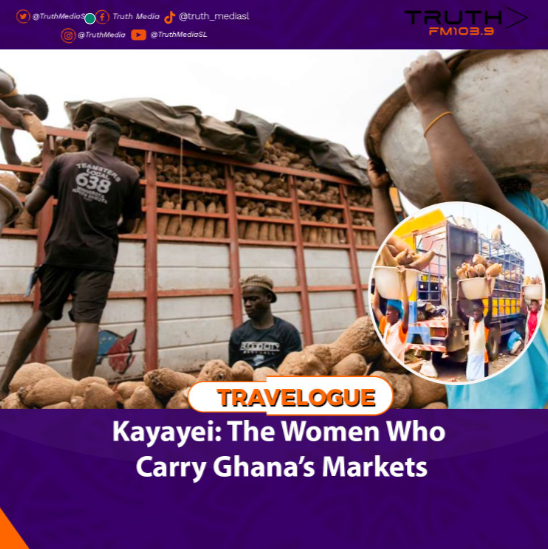
ACCRA, GHANA, 17th March 2026- In the bustling streets of Old Fadama and the yam market in Accra, Ghana, sweat meets perseverance in a daily spectacle of survival. Here, female head potters known locally as kayayei balance heavy pans on their heads, often loaded with goods weighing up to 50 kilograms, weaving through crowded alleys to earn a few cedis to sustain their families.
Yes, young and middle‑aged women carry these loads. For me, it was a culture shock. Back home in Sierra Leone, heavy lifting is the work of men, the “tote man.” Women don’t take on such jobs, which we traditionally view as roles reserved for men. In Ghana, the opposite is true.
Most of these women migrate from the northern regions to Accra in search of work, driven by poverty and lack of opportunities. Their stories are marked by hardship but also resilience. Kayayei are, in many ways, unsung heroines of Ghana’s trade system. Without them, the movement of goods in the markets would grind to a halt. They navigate narrow alleys with speed and strength, ensuring commerce flows.
Yet, behind this strength lies vulnerability. Many kayayei live in overcrowded rooms, sometimes more than ten women sharing a single space, pooling money for weekly rent. Such conditions expose them to health risks and exploitation. Language barriers and low social status often leave them at the mercy of unscrupulous traders or landlords. Still, they persevere, driven by the need to make ends meet.
Accra itself is a city of contrasts. In terms of infrastructure and systems, it is impressive. A visit to the University of Ghana at Legon felt like stepping into a city within a city, organized, expansive, and modern. But the weather was another shock. Ghana is hotter than Sierra Leone, despite both being tropical countries. It gets dark before 7 p.m., and Muslims break their fast at 6 p.m., unlike in Sierra Leone, where it’s closer to 7 p.m. These small differences fascinated me, reminding me how culture and environment shape daily life.
I experienced all this through the Fourah Bay College Faculty of Communication, Media and Information Studies partnership with the University of Illinois Urbana‑Champaign. The journey has been eye‑opening, offering me a chance to see and feel a different culture, one similar to mine, yet strikingly different in its social constructs.
The kayayei left the deepest impression. They are women of resilience, redefining gender roles in ways that challenge my own assumptions. In their strength, I saw not just survival, but a powerful story of endurance and contribution to Ghana’s economy.