By Saidu Kargbo
Freetown, 10th February 2026- At Fourah Bay College, mornings begin with uncertainty. For many students living on campus, the first question of the day is not about lectures or assignments, but whether water will flow from the taps.
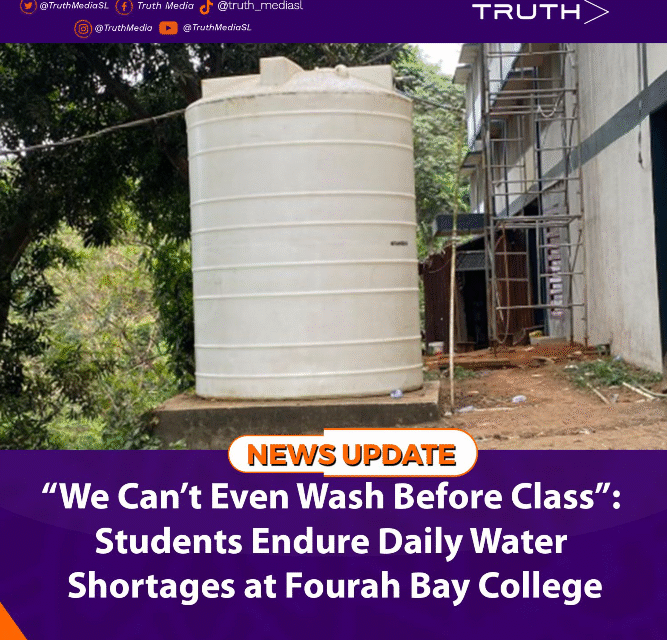
For weeks, large sections of the university have gone without a reliable supply. Tanks meant to support hostel residents often stand empty, leaving students scrambling for alternatives.
“It’s really devastating,” said hostel resident Tamba Mattia. “For the past two weeks, the taps haven’t opened and the tanks are empty. We’re left to buy water from vendors, but even that is not safe for human consumption.”
The shortage has forced students to improvise in ways that strip away basic dignity. “Sometimes the situation gets so bad that we use sachet water to bathe,” explained Richard M. Gbando. “Most times, students can’t even wash before going to classes, and that is really challenging.”
Mariama Jalloh described the crisis as emotionally draining. “We normally get water once a week, and even then we still have to buy water for 15 Leones. Hostel fees have increased so much, yet we still face this problem. It’s very disturbing.”
Beyond discomfort, students say the crisis undermines their health, confidence, and ability to focus on studies. Hours meant for learning are instead spent queuing at tanks or searching for vendors.
University authorities admit the problem is long‑standing. Deputy Vice‑Chancellor Dr. Andrew Christian Michael Baio acknowledged the “perennial water problem” and outlined plans to expand the Bathurst Dam, sink boreholes, and develop natural springs within the botanical garden.
While these proposals offer hope, students insist the present reality remains harsh. For them, the water shortage is not just about infrastructure; it is about waking up uncertain, going to class unprepared, and trying to learn in an environment where access to the most basic necessity cannot be guaranteed.