By Nafisatu Olayinka Deen
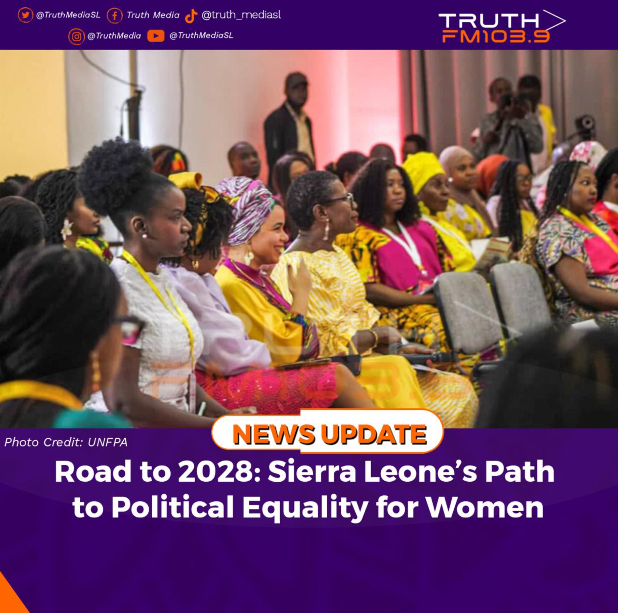
Freetown, 9th February 2026- Before Sierra Leone’s 11-year civil war, women were largely sidelined in political life. Their voices were absent from state decision-making and excluded from traditional forums that shaped policy.
The Truth and Reconciliation Commission (TRC), tasked with investigating wartime abuses and recommending reforms, highlighted this exclusion. It found that successive regimes had shut out society at large, particularly youths and women from meaningful participation in governance.
In its recommendations, the TRC urged government to ensure at least 30% representation of women in cabinet and political posts, with a long-term goal of achieving 50/50 gender parity within a decade.
Two decades later, Sierra Leone passed the Gender and Women’s Empowerment (GEWE) Act of 2022, enshrining a minimum 30% quota for women in government positions. Part 2, Section 3 (1): The president should consider appointing women to at least 30% of cabinet and government posts. Part 2, Section 3 (2): Other public appointments must also meet the 30% threshold.
This landmark legislation has been hailed as a turning point for women’s political participation and equality. Reverend Julia Bockarie, Gender Specialist with Inspiration Lifeline and Western Urban Coordinator for the 50/50 Group, praised the Act’s impact:
“Women are encouraged to participate in decision-making for their voice to be heard. There are more women in executive positions with equal pay as men now. The Act has led women to acquire more training and knowledge on electoral processes.”
Hawanatu Kargbo of the Campaign for Good Governance (CGG) agreed the law is transformative but warned of persistent challenges:
“The GEWE Act is a very important step forward. Women are now more visible in politics, and there is more discussion about leadership rights. But barriers remain, financial challenges, cultural resistance, political intimidation, and weak party support. The law is strong, but the system around it still needs improvement.”
Despite progress, critics argue the Act’s language is not forceful enough. Reverend Bockarie pointed out that phrases like “may” should be replaced with “will” to guarantee compliance. She also advocated for a “zebra style” approach alternating men and women in appointments to ensure balance. Kargbo added that enforcement remains uneven:
“Some institutions are trying to meet the 30% requirement, but others are not. Monitoring systems are weak, penalties for non-compliance are limited, and implementation is ongoing but uneven.”
Organizations like CGG have stepped in to bridge the gap, conducting civic education, policy dialogues, radio discussions, and community engagements to raise awareness of women’s political rights. Women’s groups are also monitoring institutions through gender audits, studies, and evaluations to ensure empowerment, equality, and protection of rights.
Today, women are more represented in parliament, local councils, commissions, and public boards. Yet, as Kargbo noted, they remain underrepresented in key leadership positions where influence is most critical.
“Representation is improving, but equality is not yet achieved. The GEWE Act has opened doors, but more work is needed to ensure full implementation. Grassroots organizations and civil society remain vital in monitoring progress and advocating accountability.”
Both Kargbo and Bockarie share a vision of a future where women enjoy full equality, not just in numbers but in leadership and influence.
‘This story is brought to you with support from the Africa Transitional Justice Legacy Fund (ATJLF) through the Media Reform Coordinating Group (MRCG), under the project ‘Engaging Media and Communities to Change the Narrative on Transitional Justice Issues in Sierra Leone.’