Freetown, 15th January 2026- The 2026 Global Risks Report has sounded the alarm on the growing threat of misinformation and disinformation worldwide, warning that the integrity of online news is increasingly under siege.
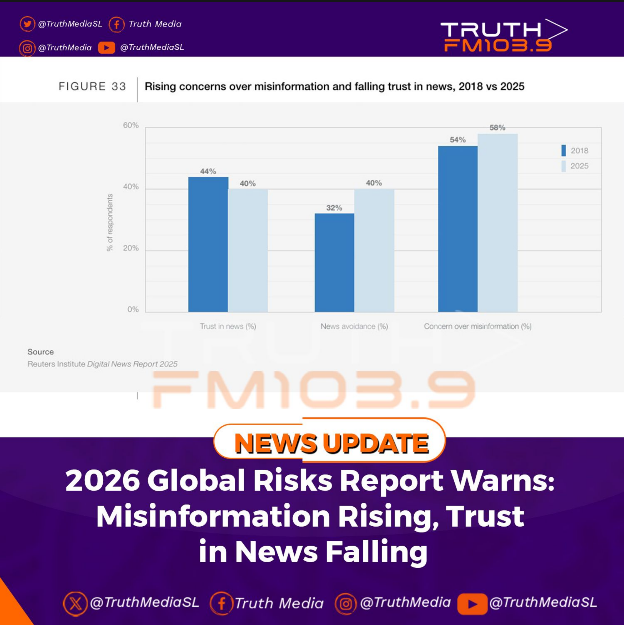
According to the Reuters Institute Digital News Report 2025, 58% of respondents globally say they are concerned about distinguishing truth from falsehood in online news. The figure is even higher in Africa and the United States, where 73% of respondents expressed concern.
Data shows a troubling shift in public attitudes toward news consumption. In 2018, 44% of respondents said they trusted news, but by 2025 that figure had dropped to 40%. At the same time, news avoidance rose sharply from 32% in 2018 to 40% in 2025. Concern over misinformation also climbed, from 54% in 2018 to 58% in 2025.
These trends highlight a widening gap between citizens and traditional information sources. While people once relied heavily on government institutions, academia, and the media, the widespread use of social media has reshaped how information is accessed, shared, and interpreted.
At the country level, misinformation and disinformation now rank among the top three risks in Europe and Eastern Asia, and second in Northern America. Globally, the issue features in the top 10 risks in 67 countries and is the highest-ranked risk in four economies.
Compounding the challenge is the rapid rise of AI tools for finding information, which jumped from 11% usage in 2024 to 24% in 2025. While AI offers efficiency, the public remains wary: surveys reveal widespread fears that AI will make news less transparent, less accurate, and significantly less trustworthy.
A particular area of concern is the proliferation of deepfakes, digitally altered videos, images, and audio recordings. Over the past five years, deepfake creation has become easier, cheaper, and more convincing. During the 2024 “super election year”, deepfakes were still relatively new, but they have since proliferated, exerting greater influence on politics and electoral processes.
Experts warn that the weaponization of deepfakes could undermine trust in democratic institutions, fuel political polarization, and even incite violence or social unrest.
The report urges global leaders to treat misinformation and disinformation not as isolated challenges but as systemic risks with far-reaching consequences. With trust in news falling, avoidance rising, and synthetic content becoming harder to detect, the stakes for democracy, stability, and social cohesion have never been higher.