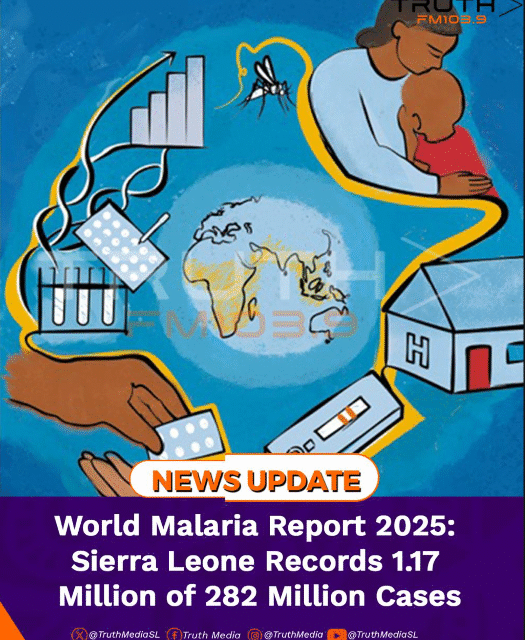
Freetown, 16th December 2025- A new global estimate from the World Health Organization (WHO) reveals that malaria remains one of the most persistent public health threats in 2024, with 282 million cases recorded worldwide. The data, visualized in a recent WHO chart, shows that Sierra Leone ranks among the top 20 most affected countries, with an estimated 1,172,000 malaria cases in 2024.
The burden is heaviest in the WHO African Region, which accounts for the vast majority of global cases. Nigeria leads globally with approximately 68,466,000 cases, followed by the Democratic Republic of the Congo (35,175,000), Uganda (13,216,000), Ethiopia (12,437,000), and Mozambique (10,220,000). These five countries alone represent nearly half of all malaria cases worldwide.
Sierra Leone’s estimated 1.17 million cases place it in the same high-burden category as countries like Burkina Faso (2,974,000), Ghana (2,926,000), and Cameroon (2,853,000). The country’s malaria figures are more than double those of Guinea (519,000) and significantly higher than Liberia (1,003,000), underscoring the scale of the challenge in the Mano River Union region.
The numbers reflect both the endemic nature of malaria and the need for sustained investment in prevention and treatment. Malaria in the West African country remains a daily reality for thousands of Sierra Leoneans, especially children under five and pregnant women.
The WHO chart also highlights disparities in malaria prevalence across regions. While Africa dominates the global burden, countries in the Americas, Eastern Mediterranean, South-East Asia, and Western Pacific regions report significantly lower figures. For instance, Guatemala is estimated to have just 230 cases, Nepal around 37, and Cabo Verde only 20.
Sierra Leone’s position in the top 20 underscores the urgency of regional coordination. There is an urgent need for cross-border surveillance, synchronized vector control, and shared data systems.
The WHO estimates are based on national surveillance data, adjusted for underreporting and diagnostic gaps. They offer an appreciable snapshot of the global malaria landscape and a reminder that, despite progress, the disease continues to exact a heavy toll.
As Sierra Leone celebrates the end of its Mpox outbreak, the malaria data is a timely reminder that the fight against infectious diseases is far from over.