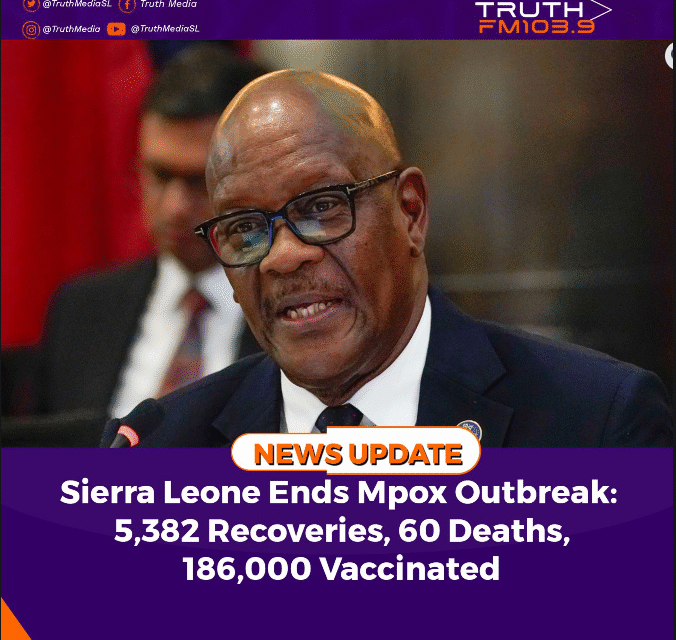
Freetown, 15th December 2025 – Sierra Leone has officially declared the end of the Mpox outbreak, marking what Health Minister Dr. Austin H. Demby described as “a defining moment in Sierra Leone’s public health journey.”
The announcement came during a ceremony at the Freetown City Council Auditorium, coinciding with the second anniversary of the National Public Health Agency.
“It is my solemn duty and my privilege to officially declare that the Mpox outbreak in Sierra Leone has ended,” Dr. Demby told the gathering of government officials, health workers, and community leaders.
According to the Minister, the declaration follows international standards, requiring more than 42 days, two full incubation periods, without a single new confirmed case. All 16 districts have surpassed this threshold, with several recording over 150 days since their last case.
The numbers behind the outbreak reveal that since the first case was detected on 9 January 2025, Sierra Leone recorded 5,442 confirmed cases, 5,382 recoveries, a 99% recovery rate, 60 deaths, representing a case fatality rate of 1.1% and zero active cases nationwide as of 15th December 2025
Dr. Demby called for a minute of silence in honour of those who lost their lives. “We honour the memory of sixty Sierra Leoneans whose lives were taken during this outbreak. Their memory strengthens our resolve to protect every life,” he said.
The Minister credited the success to a coordinated national effort. Over 186,000 people were vaccinated, with priority given to healthcare workers and vulnerable groups. More than 22,500 contacts were traced and monitored, while laboratory capacity expanded to nine testing sites across the country.
“This was a whole-of-government and whole-of-society effort,” Dr. Demby said, praising chiefs, faith leaders, and communities for bringing “public health to every doorstep.”
He expressed gratitude to President Julius Maada Bio for “decisive leadership,” and commended healthcare workers as “the true heroes of this response, many of whom placed themselves at risk to save others.”
While celebrating the milestone, Dr. Demby cautioned against complacency. “The end of this outbreak does not mean the end of vigilance. Mpox remains present in parts of Africa. We will maintain surveillance, strengthen border screening, and sustain community awareness. Preparedness is not optional; it is permanent.”
The declaration also highlighted the role of the National Public Health Agency, established in the aftermath of the Ebola crisis. “Today’s declaration validates that decision,” Dr. Demby noted, adding that Sierra Leone is “no longer defined by its past health crises.”