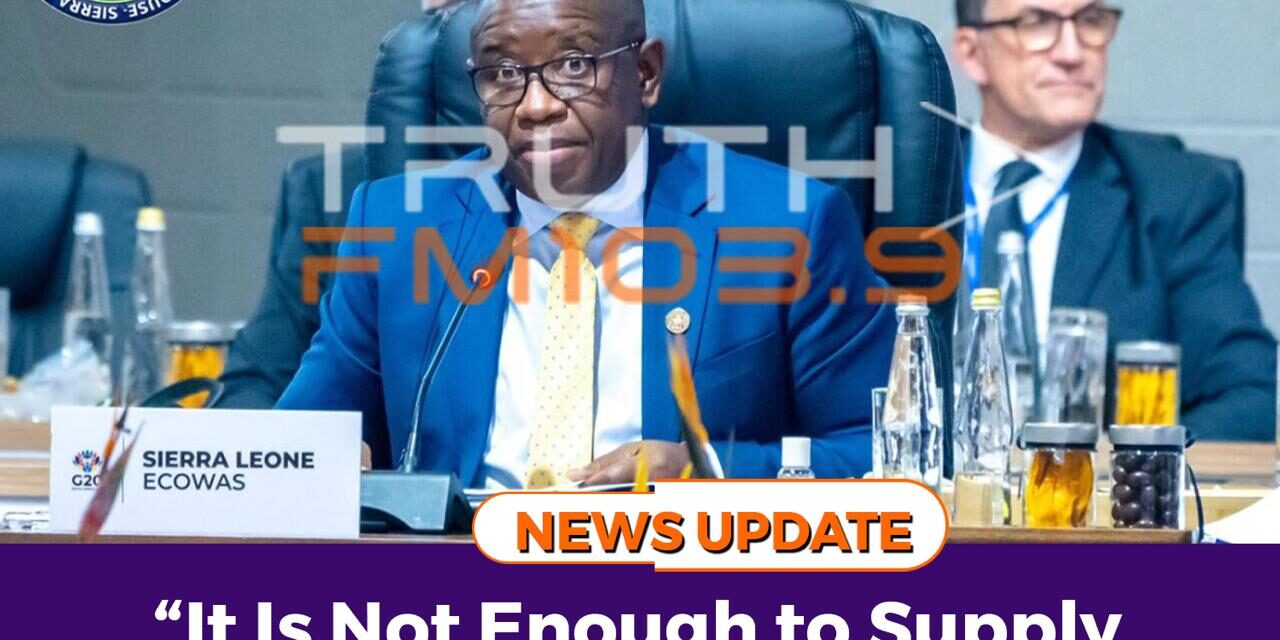
Freetown, 24th November 2025– Sierra Leone’s President and Chair of the ECOWAS Authority of Heads of State and Government, Julius Maada Bio, has placed Africa’s mineral wealth at the heart of global economic discussions, urging G20 leaders to adopt a new framework that ensures fairness and value addition in the clean-energy transition.
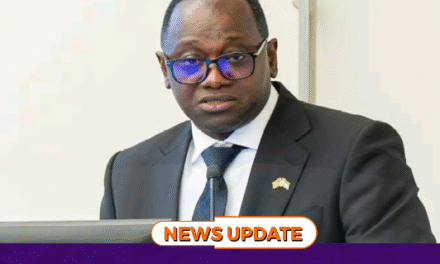
Speaking at the G20 Summit 2025 in Johannesburg, President Bio proposed the establishment of a G20–Africa Compact on Critical Minerals, describing it as “an essential framework to ensure fairness, value addition, and transparency.” He warned that without new mechanisms, Africa risks repeating a familiar pattern, where its resources fuel global prosperity while its economies capture the least value.
“Africa holds nearly one-third of the world’s critical minerals,” President Bio said, “which are indispensable to renewable technologies, advanced manufacturing and artificial intelligence.” He highlighted Sierra Leone’s own contributions through its iron ore, rutile, bauxite and diamond reserves, but cautioned that the continent remains on the margins of global value chains.
“For too long, our resources have powered global industries while our nations captured the least value. This generation must break that cycle, starting with a G20–Africa Compact anchored in justice,” he added.
The President’s remarks come amid growing calls for a more equitable energy transition. His proposed compact would promote transparent contracts, attract investment into mineral processing, and establish fair revenue models that prioritise African development and job creation.
“It is not enough for Africa to supply the minerals,” he said. “We must process them, refine them, and benefit from them. That is how we create jobs, industries, and transformation.”
Although the Summit’s theme- “Building Our Economy: The Role of Trade, Finance for Development and the Debt Burden”- covered a broad economic agenda, President Bio directed attention to the strategic importance of Africa’s mineral reserves. He argued that the clean-energy future the world is pursuing cannot be built without Africa, and therefore the continent must not be excluded from the value derived from that future.
He also linked the minerals conversation to wider economic challenges, noting that slowing global growth, tightening financial conditions and rising debt servicing continue to strain low-income economies. President Bio reiterated Sierra Leone’s support for accelerated debt restructuring, expanded Special Drawing Rights through regional development banks, and long-term financing for infrastructure, digital systems and trade.
On climate, he reminded world leaders that Africa remains disproportionately affected despite contributing less than four percent of global emissions. He cited Sierra Leone’s experience with flooding, landslides and erratic rainfall, and repeated his call for a West Africa Climate Adaptation Acceleration Facility to address food security, clean energy and coastal protection.
President Bio also stressed the need for ethical and inclusive governance of artificial intelligence. He noted that while AI and digital innovation can accelerate development, access must be fair and global frameworks must avoid deepening technological inequality.
Closing his address, President Bio urged G20 leaders to commit to a new development compact anchored in fairness and shared prosperity. He reaffirmed that the proposed G20–Africa Compact on Critical Minerals represents not only an economic opportunity, but a defining moment to correct historical imbalances and secure a just future for the continent.