Freetown, 10th November 2025- Sierra Leone’s public debt composition is undergoing a dramatic shift, with short-term domestic borrowing now accounting for a significant share of the country’s fiscal obligations, raising alarm bells over sustainability and long-term risk.
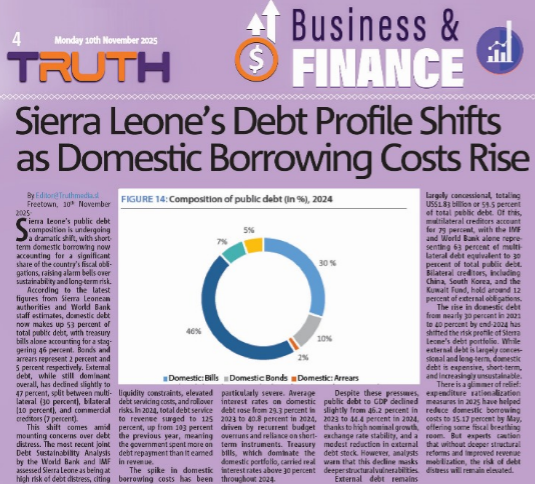
According to the latest figures from Sierra Leonean authorities and World Bank staff estimates, domestic debt now makes up 53 percent of total public debt, with treasury bills alone accounting for a staggering 46 percent. Bonds and arrears represent 2 percent and 5 percent, respectively. External debt, while still dominant overall, has declined slightly to 47 percent, split between multilateral (30 percent), bilateral (10 percent), and commercial creditors (7 percent).
This shift comes amid mounting concerns over debt distress. The most recent joint Debt Sustainability Analysis by the World Bank and IMF assessed Sierra Leone as being at high risk of debt distress, citing liquidity constraints, elevated debt servicing costs, and rollover risks. In 2024, total debt service to revenue surged to 125 percent, up from 103 percent the previous year, meaning the government spent more on debt repayment than it earned in revenue.
The spike in domestic borrowing costs has been particularly severe. Average interest rates on domestic debt rose from 29.3 percent in 2023 to 40.8 percent in 2024, driven by recurrent budget overruns and reliance on short-term instruments. Treasury bills, which dominate the domestic portfolio, carried real interest rates above 30 percent throughout 2024.
Despite these pressures, public debt to GDP declined slightly from 46.2 percent in 2023 to 44.4 percent in 2024, thanks to high nominal growth, exchange rate stability, and a modest reduction in external debt stock. However, analysts warn that this decline masks deeper structural vulnerabilities.
External debt remains largely concessional, totaling US$1.83 billion or 59.5 percent of total public debt. Of this, multilateral creditors account for 79 percent, with the IMF and World Bank alone representing 63 percent of multilateral debt equivalent to 30 percent of total public debt. Bilateral creditors, including China, South Korea, and the Kuwait Fund, hold around 12 percent of external obligations.
The rise in domestic debt from nearly 30 percent in 2021 to 40 percent by end-2024 has shifted the risk profile of Sierra Leone’s debt portfolio. While external debt is largely concessional and long-term, domestic debt is expensive, short-term, and increasingly unsustainable.
There is a glimmer of relief: expenditure rationalization measures in 2025 have helped reduce domestic borrowing costs to 15.17 percent by May, offering some fiscal breathing room. But experts caution that without deeper structural reforms and improved revenue mobilization, the risk of debt distress will remain elevated.