By Andrew Chokpeleh
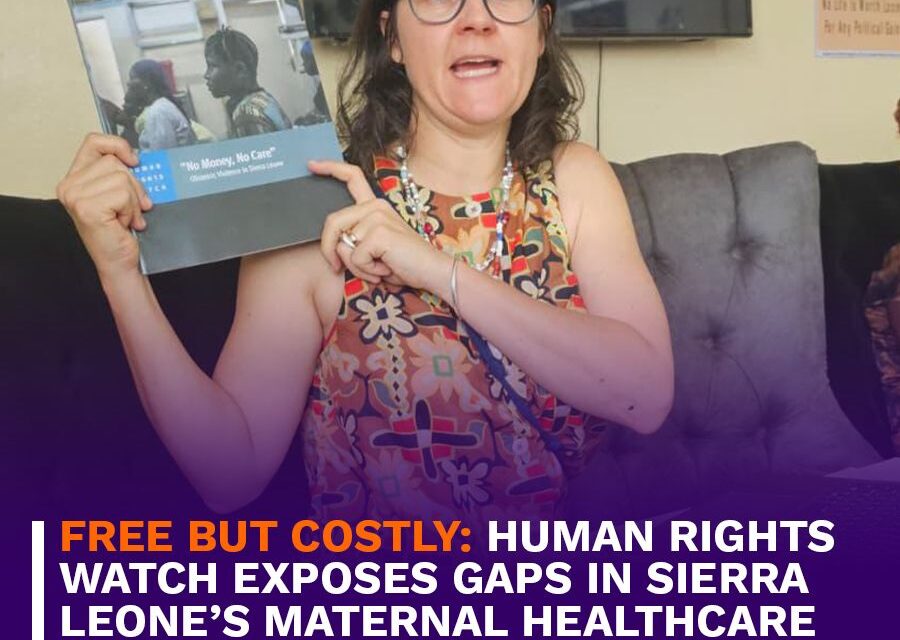
Freetown, 4th November 2025- The Human Rights Watch (HRW) in Sierra Leone has launched a new report based on research conducted on the country’s free healthcare system and the issue of maternal mortality. The bulk of this research took place in Freetown, but researchers also spoke with people in Makeni, Port Loko, and other regions across the country.
This report includes several recommendations aimed at improving the free healthcare initiative, particularly focusing on maternal care. It also proposes ways hospitals and healthcare workers can enhance the treatment and care given to pregnant women in health facilities.
Skye Wheeles, a Senior Researcher at Human Rights Watch, explained that the findings revealed that pregnant women often face serious challenges and neglect when they cannot afford to pay for medical services. According to Wheeles, this was one of the key findings of the research. She added that while the government continues to claim that the free healthcare initiative remains effective, the reality is that it faces major resource and funding challenges something the government has largely avoided acknowledging.
Wheeles noted that many pregnant women die simply because they cannot afford medical care, which remains one of the major challenges within the healthcare system. She expressed hope that the Ministry of Health and Sanitation will take the report seriously and make every effort to implement its recommendations. She emphasized that the report’s findings are not meant to portray the government negatively, but to help it understand the real challenges the healthcare system is facing.
Wheeles also highlighted the issue of volunteer workers in hospitals who demand money from patients, claiming they do not receive salaries from the government. She urged the government to look into the welfare of these volunteers to address this growing problem.
Solomon Moses Sogbanti, Section Director for Amnesty International Sierra Leone, described the report as a step in the right direction, noting that it has helped uncover several issues within the country’s health sector. Sogbanti added that the legislative arm of government needs to enact laws to reduce irregularities within the free healthcare system. He pointed out that there have been cases where nurses demand payment from patients who can barely afford the fees.
He said that even though there are ongoing campaigns discouraging home deliveries, the challenges within the healthcare system continue to make this goal difficult to achieve. Sogbanti called for the government to hold accountable any medical officials whose negligence results in patient deaths, suggesting that such officials be punished in accordance with the provisions of the Medical Examinations Act of 2021. He cited a recent incident in which a patient died after medical staff left a pair of scissors inside her abdomen following surgery.
Although there has been a reduction in maternal mortality rates, Sogbanti stressed that more still needs to be done.
He also recommended that the Ministry of Health monitor the attitudes and behavior of nurses toward patients, as some are reportedly very hostile toward women who cannot afford to pay them.
Isha Wilson Clark, Regional Women’s Leader for Amnesty International in the Western Region, also spoke on the issue. She noted that while the free healthcare initiative is a good idea in principle, nurses continue to demand money from patients and pregnant women for drugs and medical services. Some nurses reportedly ask pregnant women to buy wrappers, bandages, antiseptics, and other medical supplies directly from them, claiming that items purchased elsewhere are not the “correct” ones.
Clark said that in some cases, midwives and nurses even charge women after childbirth based on the sex of the baby. She added that the findings revealed that some pregnant women skip antenatal care visits when they cannot afford to pay nurses. Several women interviewed said that the free healthcare system does not work, as they are asked to pay money from registration up to delivery, particularly at Princess Christian Maternity Hospital (PCMH).
Clark concluded by saying that almost everyone in Sierra Leone has been affected in some way by these issues whether directly or through a relative or friend who has experienced similar challenges.
The findings from this report shed light on the urgent need for stronger oversight, increased funding, and improved accountability within Sierra Leone’s healthcare system. While progress has been made in reducing maternal deaths, the persistence of unofficial fees, neglect, and poor service delivery continues to undermine the goals of the free healthcare initiative. Human Rights Watch and Amnesty International both call on the government to act swiftly not only to uphold its commitments to maternal health but also to protect the rights and dignity of all women across the country.