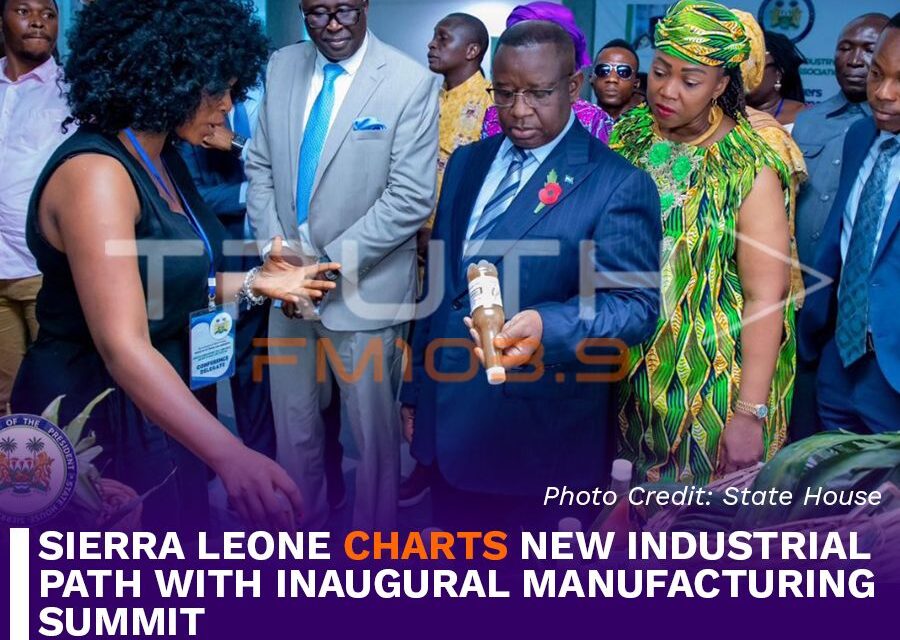
Freetown, 29th October, 2025 – President Dr. Julius Maada Bio has officially launched Sierra Leone’s inaugural Manufacturers’ Roundtable and Made-in-Sierra Leone Exhibition, pledging his government’s unwavering commitment to building a predictable, transparent, and business-friendly environment for local producers.
Speaking at the Bintumani Conference Centre in Freetown, President Bio described the event as a turning point in Sierra Leone’s industrial journey, a move to end the export of raw materials and reduce reliance on imported goods.
“Whenever we export raw materials, we export jobs and boost other nations’ economies,” the President declared. “We are building an economy that consumes what we produce and exports what we make.”
To accelerate industrialization, President Bio unveiled three strategic initiatives: The Made-in-Sierra Leone Presidential Promotion, the National Manufacturing Roadmap and the National Manufacturing Pact
These efforts aim to boost local production, enhance competitiveness, and position Sierra Leone as a regional manufacturing hub. He emphasized that manufacturers in Sierra Leone have access to nearly 400 million consumers in West Africa and 1.4 billion across the continent, citing the country’s strategic location and market potential.
“Industrialization begins with mindset and national pride,” President Bio said. “Every product made in Sierra Leone is made by our people. When we buy made-in-Sierra Leone, we create jobs and build our economy.”
He called for transparency, quality production, and adherence to international standards, noting that these principles are essential for building trust and expanding exports. The President expressed hope that the roundtable would yield three key outcomes: A roadmap for fiscal coherence, an action plan for an enabling business environment and a framework for inclusive growth.
Minister of Trade and Industry, Ibrahim Alpha Sesay, hailed the event as a milestone in the implementation of the Medium-Term National Development Plan (MTNDP). He announced plans to establish four Special Industrial Zones (SIZs) and revive the Koindu International Market, adding that 25 factories have been established since 2018, diversifying the economy through manufacturing.
World Bank Country Manager, Abdu Muwonge, noted that manufacturing currently contributes 8.8% to Sierra Leone’s GDP, and highlighted the country’s natural harbor as a strategic asset for regional exports.
UNIDO Country Representative, Mariatu Swaray, reaffirmed support for climate-smart manufacturing, innovation, and quality infrastructure. “Manufacturing is where our future lies,” she said.
Minister of Finance, Sheku Ahmed Fantamadi Bangura, assured stakeholders of a stable macroeconomic environment, citing currency stability, reduced inflation, and lower prices. “We have a sound legal system and respect all agreements with manufacturers,” he said. “Financial institutions should now do their part by providing access to finance.”
Representing the private sector, Albert Ojo Collier, President of the Manufacturers’ Association, thanked the government for prioritizing industrial recovery after the civil war, Ebola, and COVID-19.
The event concluded with a unified call for stronger partnerships between government, development agencies, and private sector players to drive Sierra Leone’s industrial transformation through innovation, investment, and inclusive growth.