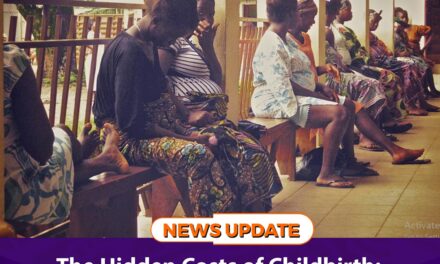
By Davida Spaine-Solomon
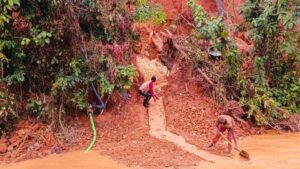
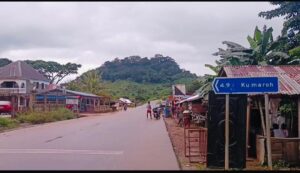
Kono District, Sierra Leone, 20th October 2025- Every morning in Kumao Village, Nimikor Chiefdom, men, women, and even children take the long walk to the mining pits. Some carry shovels others, pickaxes, and some go with nothing but empty pans and hope. For many, artisanal mining is the only way to put food on the table, but it comes at a deadly cost.
Grace Koniwa is one of the few female gold miners in Kumao. At 32, she has spent nearly a decade in the mines. Her palms are calloused, and her voice carries the weight of someone who has seen too much.
“Mining is how we survive, but every day we go to the pits, we don’t know if we will return home alive,” she says, sitting under a mango tree after a long morning of work. “We are exposed to danger every single day; falling pits, landslides, even floods when it rains.”
 Grace’s story is echoed by countless others who risk their lives daily. Artisanal mining, often referred to as “informal” or “subsistence” mining, employs hundreds of thousands across Sierra Leone. It is backbreaking labour; digging deep pits with rudimentary tools, often without helmets, boots, or any form of protective gear. And when tragedy strikes, the losses ripple far beyond the mining site.
A Family Shattered by an Orbaba- For Fatmata Kamara, a mother of three, tragedy came on a seemingly ordinary day.
“That morning was just like any other,” she recalls. “We woke up, ate together, and my brothers left for the mining site as they always did.”
But hours later, a chilling message reached her: a pile of sand had collapsed on miners. Locally, this is called an orbaba, a word that sends shivers through mining communities because it almost always means death.
“When I reached the site, I saw my two brothers lying lifeless,” Fatmata says, her voice breaking. “There was nothing anyone could do. The authorities came, investigated briefly, and later brought the bodies to our doorstep.”
The loss has left a gaping wound in her family. “One of my brothers left two children behind. Since that day, we have not received any support from anyone. We buried them ourselves. I am calling on the government to ensure our safety at these mining sites, so other families don’t have to go through this pain.”
Her grief is compounded by the lack of follow-up or accountability. For many mining families, death is not only sudden but also treated as routine.
Deaths That Go Unrecorded– Isaac Bitukan also lost his younger brother in a cave-in. His account underscores a troubling reality; most mining deaths never make it into official records.
“My brother was in the pit that day, and I was up the hill when it happened,” Isaac explains. “We shouted for help, but by the time we got him out, he was already gone.”
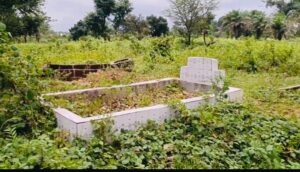
Authorities, he says, rarely arrive in time to conduct proper investigations. “These sites are far from town. By the time the news reaches them, it is too late. When they come, they just observe and leave. There is no record, no report, nothing.”
For Isaac, the loss has been devastating. “My brother was our main source of support. Since he died, things have been very hard for us. No one has come to help. I want the government to send professionals to teach us how to mine safely. Or better still, bring skill training programs for young people so they can find other ways to earn a living.”
His suggestion highlights a critical gap: alternative livelihoods. Many young people in Kono are drawn into mining not because they want to, but because there are no other opportunities.
A Community Trying to Act– Local leaders are aware of the danger and are taking steps to reduce it. Shar Gborie, Chairman of the Mining Committee, says they have set up a task force to address the growing number of accidents.
“Our task force visits different mining areas to raise awareness on safety measures,” he explains. “We tell miners to avoid digging too deep without proper support and to fill abandoned pits to prevent accidents.”
But their efforts are limited by resources. “We don’t have enough equipment or funding,” Gborie admits. “We are doing what we can, but we need government backing and technical support to make a real difference.”
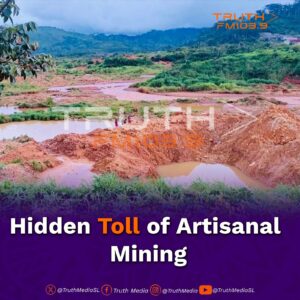
Government Silence and the Search for Accountability- Efforts to get a response from government authorities on the safety of artisanal miners have so far proven unsuccessful. Local residents say this silence is part of a pattern when deaths occur. They say officials may visit briefly, but there are rarely investigations, compensation, or long-term solutions.
The Bigger Picture: Artisanal Mining in Sierra Leone- Artisanal and small-scale mining (ASM) is a major contributor to Sierra Leone’s economy, particularly in Kono District, which is rich in diamonds and gold. The sector provides jobs for thousands but is largely informal, meaning many miners work outside government oversight.
According to international mining watchdogs, ASM accounts for a significant portion of Sierra Leone’s mineral exports, yet miners receive a small fraction of the wealth generated from the resources they extract. This economic imbalance drives many to dig deeper and work longer hours, increasing the risk of fatal accidents.
Experts say improving safety requires a multi-pronged approach:
Regulation and Monitoring: Government agencies must regularly monitor sites and enforce safety rules.
Training and Equipment: Miners need basic training on safe excavation techniques and access to protective gear.
Alternative Livelihoods: Skill development programs could help young people transition into other trades.
Community Awareness: Continuous sensitization is needed to reduce risky practices, such as working during heavy rains.
Expert Insights: The Call for Formalization– Given NMJD’s long-standing work on justice, rights, and community empowerment, Emmanuel M. T. Gbondo Esq. a Legal and Development Practitioner and Programme Lead for Mining and Extractives at Network Movement for justice and development [NMJD] says the artisanal mining subsector remains one of Sierra Leone’s most unregulated yet vital livelihoods.
He explains that Sierra Leone’s mining industry operates on three scales large-scale, small-scale, and artisanal but the latter is the least formalized. “Artisanal mining is typically done on land no larger than 2.5 acres and not deeper than ten meters,” he notes. “However, many miners now use machines despite restrictions in the law. The sector lacks proper licensing, safety compliance, and welfare structures for workers.”
Gbondo laments that with only about 200 mining compliance officers nationwide, government monitoring is severely limited, leaving miners vulnerable to accidents, exploitation, and poor working conditions. “Most diggers are hired daily without contracts or insurance. If someone dies in the pit, their families receive only sympathy, not compensation,” he says.
He also highlights that though the law reserves artisanal mining for Sierra Leoneans, foreigners often exploit loopholes by using locals to obtain licenses. “Formalization,” he emphasizes, “would bring structure ensuring environmental safety, fair remuneration, and better oversight.”
NMJD, he adds, continues to work with communities to promote safer and more sustainable mining practices through awareness and capacity building. “Our work focuses on helping miners understand the dangers of unsafe mining and the importance of compliance. Community involvement is key they live closest to the mines and can help monitor unlicensed activities.”
While acknowledging calls to ban artisanal mining, he believes the solution lies not in prohibition but in reform. “Artisanal mining sustains thousands of families. What we need is a law that protects both the environment and the miners themselves.”
A Cry for Change– For Grace, Fatmata, and Isaac, these solutions cannot come soon enough. “We are not saying government should stop us from mining,” Grace insists. “But at least give us training and protect us. Our lives matter too.”
Fatmata’s plea is more personal. “I don’t want another sister to go through what I went through. I want my children to grow up knowing that mining does not have to mean death.”
As the sun sets over Kumao, miners pack up their tools and make their way home. For now, they have survived another day but tomorrow, the danger will be waiting again.
Until real safety measures and livelihood alternatives are put in place, the hidden toll of artisanal mining will continue to claim lives, leaving behind grieving families and unmarked graves.
“This investigation was supported by BBC Media Action and funded by Deutsche Gesellschaft für Internationale Zusammenarbeit (GIZ) GmbH on behalf of the German Federal Ministry of Economic Cooperation and Development (BMZ), co-funded by the European Union (EU).”