
By Nafisatu Olayinka Deen
Freetown, 22nd September, 2025 – “Every day I hawked within the eastern part of Freetown, searching for a place to rent for five whole months, but I couldn’t get any!” said Amidu, his voice heavy with frustration.
His story is not unique. It echoes the lived reality of thousands of Sierra Leoneans caught in the grip of Freetown’s worsening housing crisis.
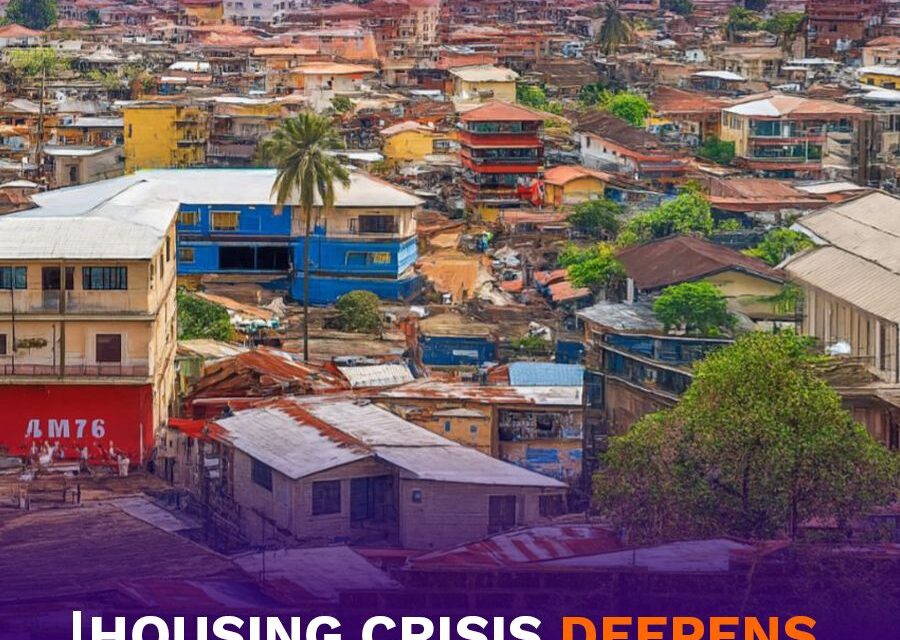
According to the Freetown City Report by urban development expert Joseph M. Macarthy, the capital is facing an acute housing shortage. The 2024 report outlines a grim landscape: limited private-sector investment, soaring land costs, and a government still struggling to attract meaningful partnerships for affordable housing, despite offering numerous concessions.
Most homes in Freetown are built and rented out by private individuals, leaving the sector vulnerable to market volatility and unchecked pricing. The challenges are layered: an inefficient land market, exorbitant building material costs, and a lack of affordable, serviced land have all contributed to the rapid expansion of informal settlements.
“Some single rooms now cost ten thousand leones yearly in parts of Freetown,” said Jonathan, a local housing agent. “That’s outrageous for middle- and low-income earners. Many are forced to settle in slums, coastal areas, or the mountains where rent is cheaper but conditions are dire.”
Amidu’s experience reflects this harsh reality. “Most places I found were either too expensive or lacked basic amenities. It was a difficult search,” he said.
Legal expert Kamara Esq. added, “Freetown’s rental market suffers from price volatility, weak tenure security, and substandard living conditions especially in informal settlements.” He noted that even before recent economic shocks, the city had 68 informal settlements, sheltering about 35% of the population. “This statistic alone shows the scale of the problem and the urgent need for enforceable rent rules.”
Earlier this year, a coalition of stakeholders including the Minister of Lands, housing experts, and civil society organizations met to address the crisis. Yet, the struggle persists. Families continue to live in overcrowded, unsafe conditions, burdened by high land costs and an unregulated rental market.
“A substantial share of residents live in precarious housing,” Kamara continued. “Large household sizes, irregular incomes, and common tenancy make them vulnerable to sudden rent hikes and unlawful evictions.”
Jonathan confirmed that many landlords now demand rent in U.S. dollars. “They blame inflation and the rising cost of construction materials. Renovations are expensive, so rent prices go up and tenants suffer.”
Mamadu, another Freetown resident, shared his ordeal: “It’s extremely expensive to rent even a single room in central Freetown. That’s why people turn to disaster-prone communities because the houses there are cheaper.”
Kamara pointed to Cap 52, a legal provision that could help regulate the market. “It allows for Rent Assessment Committees to determine fair rents and offers an appeals process. But in practice, these committees are underfunded, poorly known, and lack enforcement power so arbitrary rent increases continue unchecked.”
Kadijah, who has also struggled to find a decent apartment, believes the solution lies in formal government-led housing. “If enough formal settlements were provided at reasonable prices, it would ease the burden on citizens and improve the city.”
In response, the Sierra Leone Housing Corporation (SALHOC) and Banga Group have stepped forward with a plan to build 5,000 affordable homes nationwide. Following a July 2025 Memorandum of Understanding, both parties inspected over 380 acres across Mile 6, Mapara, and Macdonald, land earmarked for construction.
While the SALHOC-Banga partnership offers hope, the scale of Freetown’s housing crisis demands more than promises. It requires sustained investment, regulatory reform, and a commitment to making housing a right, not a privilege, for every Sierra Leonean.








This is absolutely true. The housing crisis in Freetown is soaring higher every single day. And there are reasons for that. Some were mentioned in this article and others weren’t. So let me summarize.
I’m Hamidu Ansumana a real estate agent and the CEO of Mana Estate Services Ltd.
And here’s my expert opinion.
Reason.
1. Population growth: in the capital is one big challenge the government needs to address. Not by stopping internal migration but by catering for the increasing population because that is very common among all capital cities in the world. Everyone moves to where the opportunities are.
POSSIBLE SOLUTIONS: Encourage real estate developers and soften regulations for them. Build government Lowcost houses.
2. Political Landscape: The past and present political landscape is largely discouraging the diaspora from investing into real estate back home. The government needs to put in the same effort it’s putting into attracting foreign direct investments to attracting our own brothers and sisters who are living in diaspora to come back home and invest into our housing and other sectors. We should not put all our hopes in foreigners to give us donors cos that’s cheek and comes with no dignity. And note: The diaspora will not just come back when there are problems everywhere, drugs, political confrontations between the ruling party and the opposition parties.
POSSIBLE SOLUTIONS: Give diasporas incentives for investing in Sierra Leone. Give them access to loans & grants, give the locals access to mortgages in the banks.
3. Unregulated Real Estate Market: As mentioned in your article. The citizens are at the mercy of the unfortunately unregulated market. Knowing all of us (Sierra Leoneans) for being wicked to ourselves, we’re constantly looking for loopholes to exploit others thinking we’re better than them. The conversation about housing needs to be talked about like we’re currently talking about drugs in Sierra Leone. Because property owners charge exorbitantly without fear of any consequences. Government officials (ministry of lands) aid land grabbers to sell poor people’s lands, the activities of real estate agents are not checked or cautioned, etc.
POSSIBLE SOLUTIONS: Enforce real estate laws and regulations, control rental prices, give licenses to real estate agents. Etc.
4. Inflation: As you rightly pointed out in your article. The rising costs of housing is largely influenced by the high costs of building materials, construction, and renovation.
POSSIBLE SOLUTIONS: Give incentives or concessions to importers of building materials. Make the business environment easier for them.
5. Neglecting Rapidly Growing Communities. The city is congested, people are reluctant to vacate disaster prone areas, landlords charge anyhow for rent. Well, all these is because there are limited or no alternatives to what’s available now. But there are still possibilities. Because there are many underdeveloped communities that have all been sold out but not built because these communities lack basic amenities like good roads, electricity, water and recreational facilities etc which are reasons why the people who have bought lands in these communities are not willing yet to start building there yet.
POSSIBLE SOLUTIONS: Invest heavily in newly growing communities off the city like Waterloo, four mile, six mile, peninsula etc. give them paved roads, and electricity that’s all. Those places will attract more people thereby reducing the population in the city and slums.